Custom menu boards for Delaware restaurants: digital, static, and window menus. Pricing guide, design tips, and local installation from a Wilmington sign shop.
Why Your Menu Board Is Your Best Salesperson
Every restaurant owner in Delaware knows the basics of running a profitable kitchen — good food, fair prices, clean tables. But there’s one revenue lever most owners underinvest in: the menu board. It’s the single piece of signage every single customer stares at before spending money, and a well-designed board can steer $2–$4 more per ticket without changing a single recipe. For restaurants, cafés, food trucks, and takeout spots across Wilmington, Newark, and Bear, the menu board does more selling than any server or cashier — it’s the first point of decision, and it sets the price-to-value perception before a single plate hits the table. This guide covers the types of menu boards available to Delaware restaurant owners, what each option costs, the design principles that actually increase sales, and how to get a custom board designed and installed locally. Whether you’re opening a new spot on Main Street, refreshing a Route 40 takeout counter, or launching a food truck for the summer season, the right menu board pays for itself faster than almost any other investment in your front-of-house.
Types of Menu Boards for Delaware Restaurants
Delaware restaurants have four main options, and many of the most effective setups combine two or three. The right mix depends on your service style, how often your menu changes, the lighting in your space, and how much wall or counter real estate you have to work with.
Static Printed Menu Boards
The workhorse of the industry. Printed menu boards use full-color vinyl applied to a rigid substrate — typically aluminum composite, PVC, or acrylic — and mount directly to the wall or counter. They’re the most affordable option and the most common choice for counter-service restaurants, pizza shops, delis, and casual dining across Delaware. A well-designed static board with removable magnetic price strips or a dedicated LTO panel can handle seasonal changes without a full reprint. The key design investment happens once, and the board serves for years with occasional price-strip swaps. Expect to pay $150–$800 depending on size, substrate, and design complexity.
Digital Menu Boards
Digital boards use commercial-grade LCD or LED screens to display menus that change instantly. They’re the right call when your menu shifts daily (specials, soups, sold-out items), when you run daypart menus (breakfast/lunch/dinner on one screen), or when you want animation and motion to draw the eye. A single 43–55” screen setup starts around $600–$1,200, and a multi-screen installation with content management software runs $1,500–$3,000. The hardware cost is higher upfront, but digital eliminates reprint costs entirely and lets one manager update every board from a phone in seconds.
Window Menu Graphics
One of the most underused tools in the Delaware restaurant playbook. Full-color vinyl or perforated window film applied directly to your storefront glass displays your menu to every pedestrian and driver who passes — 24 hours a day, with zero staff involvement. Window menus are especially effective on high-foot-traffic strips like Newark’s Main Street and the Wilmington Riverfront, where thousands of people walk past daily deciding where to eat. They also solve a practical problem for takeout-heavy spots: customers can read the menu from outside and walk in ready to order. Printed window menus typically cost $100–$400 and install in under an hour.
Chalkboard & Framed Menus
A lower-cost option that works well for cafés, coffee shops, and bars where a handcrafted feel matches the brand. Framed printed menus and wall-mounted chalkboards give you flexibility at a lower price point than a full wall installation. The trade-off is durability and professional polish — they work for the right concept, but they won’t hold up in a high-volume kitchen environment the way a printed or digital board will.
Menu Board Pricing in Delaware
| Option | Typical Cost | Best For | Lifespan |
|---|---|---|---|
| Printed vinyl on rigid substrate | $150–$800 | Counter-service, delis, pizza shops | 5–7 years |
| Digital (single screen) | $600–$1,200 | Frequent menu changes, dayparts | 5+ years (hardware) |
| Digital (multi-screen with CMS) | $1,500–$3,000 | Multi-station QSRs, full digital | 5+ years (hardware) |
| Window menu graphics | $100–$400 | Foot-traffic visibility, takeout | 3–5 years |
| Chalkboard / framed print | $50–$200 | Cafés, bars, low-volume concepts | 1–3 years |
A menu board isn’t a decoration — it’s a sales tool that pays for itself in higher check averages. The $400 static board that adds $2 per ticket across 50 customers a day pays itself off in four days.
Prices are estimates for the northern Delaware market. Every project gets a measured, itemized quote. The final number depends on board size, substrate choice, design complexity, and whether you supply print-ready artwork or need design from scratch.
5 Design Rules That Increase Sales
Research from menu-engineering studies and point-of-sale data consistently shows that how you present your menu changes what people order — and what they spend. These five rules apply whether you go digital, static, or window-mounted.
1. Spotlight your BAMs. Your BAMs — high-profit, high-popularity items — should get the largest photos, the boldest placement, and the most surrounding white space on the board. Most customers scan a menu in under 10 seconds while a line forms behind them. If your most profitable item blends into a wall of text, they’ll default to something familiar instead. Put a large, appetizing photo of your best-seller in the board’s visual hot zone — typically the upper-center or upper-left, depending on your counter layout — and watch it outsell everything else.
2. Limit choices to seven or fewer per category. It sounds counterintuitive, but shorter menus sell more. When customers face too many options, they experience decision fatigue, fall back on the safest choice, and often spend less. Research consistently shows that six to seven items per category is the sweet spot between variety and decisiveness. If your full menu has 30 items, group them into four or five named categories rather than one long list.
3. Size your type for the real viewing distance. The single most common menu board mistake: text that’s too small to read from where customers actually stand. For printed boards, use a minimum letter height of 3/8 inch (~36 pt) for every 6 feet of viewing distance. If your customers stand 10–12 feet from the board at the counter, your body text needs to be at least half an inch tall. On digital screens, a 48-inch display needs roughly 24-point type at 4–5 feet and 34-point at 5–7 feet. Design for the back of the line, not the front.
4. Simplify your pricing. Dollar signs, decimal points, and trailing zeros add visual noise that subconsciously reminds customers they’re spending money. Menu-engineering research from Cornell found that guests spend significantly more when prices appear as plain numbers — “12” instead of “$12.00.” Keep your price format clean and consistent, and use a subtle font weight or color to separate price from description so the item name stays prominent.
5. Design for change from day one. Every menu board will change — prices go up, seasonal items rotate, LTOs come and go. If your board design treats every element as permanent, a single price change means a full reprint. The fix: build removable price strips, magnetic LTO panels, or digital daypart zones into the design from the start. A static board with swappable price strips might cost 10–15% more upfront but saves hundreds in reprint costs over its lifespan. On digital, define content zones (core menu, daily special, LTO, sold-out flag) so updates drop in cleanly without breaking the layout.
Indoor vs. Outdoor Menu Boards
The environment where your board lives changes the material and lighting requirements significantly. Indoor boards in a well-lit dining room can use non-illuminated substrates like aluminum composite or PVC without issue. But the moment a board faces direct sunlight — through a storefront window, at a walk-up window, on a food truck — you’re in a different conversation.
Outdoor and window-facing boards need UV-resistant inks and laminate to prevent fading under Delaware’s summer sun. They also need higher contrast: black text on a light background reads better in bright ambient light, while backlit or illuminated boards are nearly essential for evening visibility. For food trucks and walk-up windows, we recommend rigid aluminum composite with a matte laminate to kill glare — glossy surfaces in direct sun become unreadable mirrors.
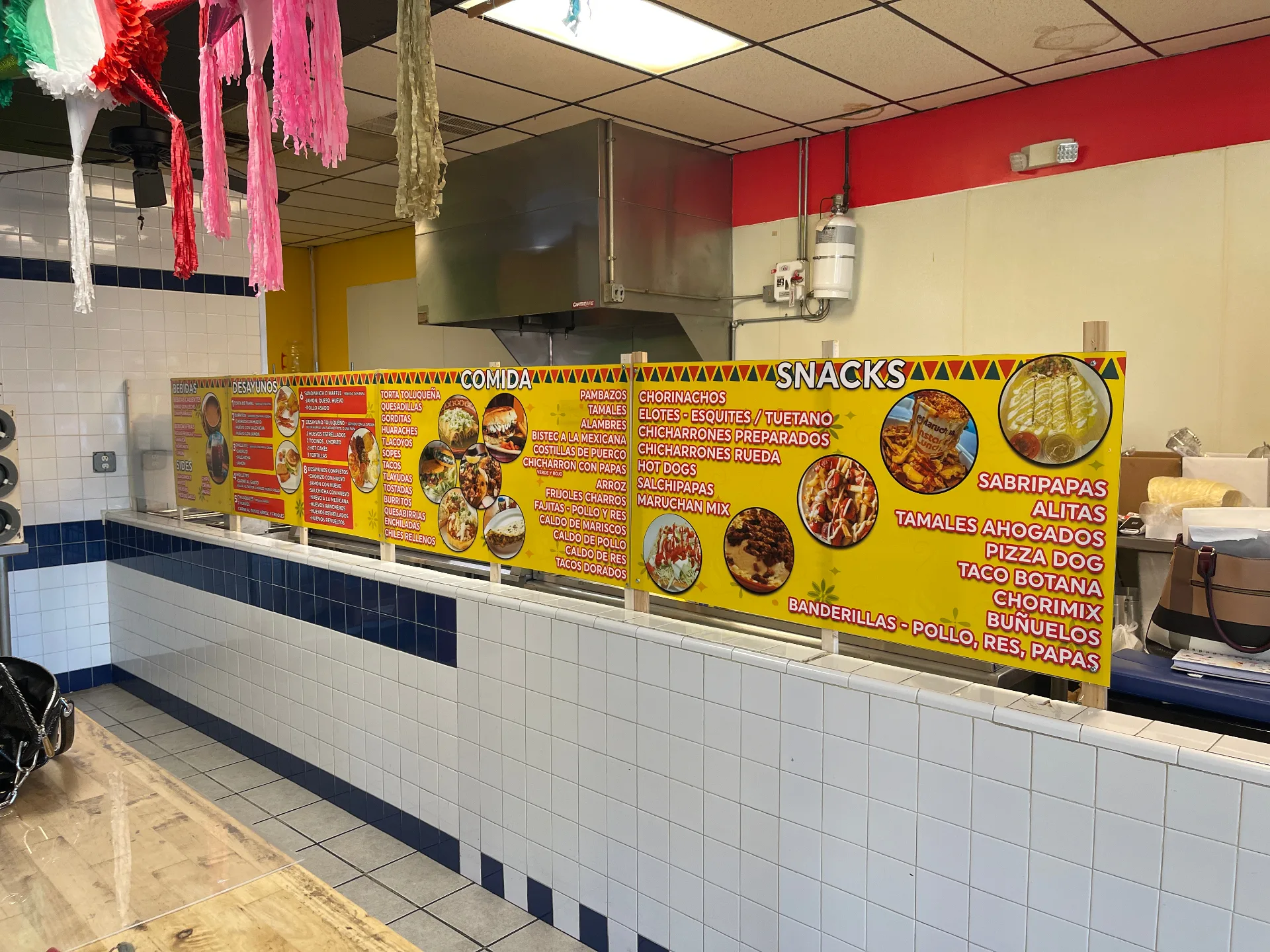
At ZeroDegree Signs, we produce and install indoor and outdoor signage for restaurants across Wilmington and Newark, including the menu board for Taquería Atexcac and window menus for several local eateries. We spec the right materials for your specific mounting location so you don’t find out the hard way that indoor vinyl can’t handle a south-facing window.
How Delaware Restaurants Use Multiple Boards Together
The most effective restaurant signage strategy in Delaware isn’t one board — it’s a system. Here’s the combination we see working best at local spots:
- A wall-mounted menu board behind the counter handles the full menu and is the primary ordering reference.
- Window graphics facing the street or sidewalk pull in foot traffic and let passersby decide before they walk in. A simple “Menu” header with 3–5 featured items and your hours is often enough to turn a window-shopper into a customer.
- A sidewalk A-frame or vinyl banner outside the door announces daily specials, happy hour, or new menu items to people already walking past.
- A countertop or table tent reinforces LTOs and upsells at the point of sale — desserts, drinks, catering inquiries.
Together, these four touchpoints create a customer journey from sidewalk to table that requires zero staff effort beyond the initial installation. For a restaurant on a busy Delaware corridor, that system generates more revenue per square foot of signage than any single board alone.
Get a Custom Menu Board for Your Delaware Restaurant
Ready to put your menu to work as a sales tool instead of just a list? ZeroDegree Signs designs, produces, and installs custom menu boards for restaurants, cafés, food trucks, and takeout spots across Wilmington, Newark, Bear, and all of New Castle County. We handle every step in-house — measuring your space and sightlines, designing a board that reflects your brand and highlights your most profitable items, printing on the right substrate for your environment, and installing it professionally so it looks clean and stays put for years.
Whether you need a single printed board for a new counter-service opening, a digital screen setup for daypart menus, window graphics that pull foot traffic, or a full system that works together, we’ll walk you through the options and deliver an itemized quote before any work begins — usually within 24 hours. Call or text (302) 401-0204 to get started, tell us about your restaurant and space, and we’ll help you build a menu board that actually earns its keep.
Frequently Asked Questions
A printed vinyl menu board typically costs $150–$800 depending on size, materials, and complexity. Digital menu boards start around $600 per screen for a basic setup and $1,500–$3,000 for a multi-screen installation with content management. Window menu graphics fall in the $100–$400 range. Every project gets a free, itemized quote from ZeroDegree Signs before any work begins.
It depends on how often your menu changes. If you update daily specials, rotate seasonal items, or adjust pricing more than six times a year, digital usually pays for itself in saved reprint costs and staff time. If your core menu stays consistent and changes are rare (one seasonal LTO per quarter, for example), a well-designed static board with removable price strips or a magnetic LTO panel is the more cost-effective choice. Many Delaware restaurants use a hybrid: a static core menu with one digital screen for daily specials and promotions.
Three design decisions move the needle the most. First, highlight your high-profit, high-popularity items — called 'BAMs' — with larger photos, bold placement, and more surrounding space. Second, limit choices to seven or fewer per category to reduce decision fatigue and speed up the line. Third, design for the real viewing distance: minimum letter heights of 3/8 inch for every 6 feet of distance, and higher contrast for backlit or outdoor boards.
Yes. ZeroDegree Signs installs menu boards at restaurants across Wilmington, Newark, Bear, and all of New Castle County. We handle everything in-house: measuring your space, designing the board to fit your layout and brand, printing or sourcing the hardware, and professional installation. Most projects are completed within 5–10 business days of design approval.
Absolutely. Window menu graphics are one of our most popular products for Delaware restaurants — they advertise your menu to pedestrians and drivers 24/7 with zero recurring cost. We print on full-color vinyl or perforated window film, and the graphics install cleanly and remove without residue when you want a change. They're especially effective on Main Street in Newark, the Wilmington Riverfront, and high-traffic strip centers along Route 40 where foot traffic is constant.
Get a Free Quote from ZeroDegree Signs
Serving Wilmington, Newark, Bear & all of New Castle County, DE.